From the blog
What Actually Helps Digestion: The Boring Answers, Ranked
For most people the order is: more fibre from food, regular unhurried meals, enough water, daily movement and sleep, then patiently finding your own trigger foods. A named-strain probiotic or a specific enzyme helps some people for specific reasons. A herbal blend with unpublished amounts is the least certain option on the list.

Why this list is in this order
Every supplement page you read implies the same hierarchy: the product first, lifestyle as a footnote. The real hierarchy is the other way round, and it is not close.
This is not a moral argument about doing things the hard way. It is about effect sizes. Getting an adult from 12 grams of fibre a day to 28 makes a difference you can measure in a week. Most digestive supplements have effects that are hard to detect at all outside a trial, and several have none.
So here is the honest ranking, with supplements sitting exactly where they belong in it rather than at the top.
1. Fibre, from food
Fibre is the single highest-yield change for everyday digestion, and most adults eat about half of what is recommended. US guidance sits around 25 to 38 grams a day depending on age and sex; typical intake is closer to 15.
It works in two ways. Soluble fibre (oats, beans, lentils, apples, psyllium) absorbs water and forms a gel, which softens stool and slows things a little. Insoluble fibre (wholegrains, skins, nuts, vegetables) adds bulk and speeds things up. Real foods carry both, which is why the advice is annoyingly non-specific: eat more plants, of more kinds.
| Food | Roughly | Fibre |
|---|---|---|
| Black beans, 1 cup cooked | About 15 g | |
| Lentils, 1 cup cooked | About 15 g | |
| Raspberries, 1 cup | About 8 g | |
| Oats, 1 cup cooked | About 4 g | |
| Wholegrain bread, 2 slices | About 4 g | |
| Apple with skin | About 4 g | |
| Almonds, 1 oz | About 3.5 g |
2. How and when you eat
A surprising share of everyday discomfort is mechanical rather than nutritional: eating fast, eating late, eating standing up, very large single meals, a lot of carbonation, and chewing gum, which swallows air.
None of that costs anything to change, and for reflux in particular the timing of the last meal of the day outperforms most products on the shelf.
Slow down by five minutes
Chewing is the only digestive enzyme you already own and never have to buy.
Stop eating two to three hours before bed
Gravity is free, and reflux responds to it.
Keep meal times roughly regular
The gut has its own clock and dislikes surprises, which is why travel upsets it.
Sit down
Rushed standing-up meals turn up in symptom diaries far more than people expect.
Watch the drinks
Fizzy drinks, big coffees and alcohol are all common, ordinary culprits.
3. Water, movement and sleep
Fibre without fluid makes constipation worse, so the two go together. There is no magic number of glasses; pale straw urine is the free test that works.
Movement matters more than people think. Walking after meals helps gastric emptying, and daily activity is one of the more consistent findings in constipation research. It does not have to be exercise in the gym sense.
Sleep is the one people leave out. Short sleep changes appetite hormones, raises stress hormones and is associated with worse gut symptoms across several conditions. If you are sleeping five hours and buying a digestive capsule, the capsule is not where your money should go first.
4. Finding your own triggers
Beyond the general advice, digestion is individual. Lactose, fructose, certain sweeteners, very fatty meals, caffeine and alcohol are common culprits, and the only way to find yours is to keep notes and change one thing at a time.
Two warnings about doing this. First, a week is not long enough to conclude anything, because symptoms fluctuate anyway. Second, cutting whole food groups for months without supervision has real costs, both nutritional and social. Structured elimination diets work best with a dietitian rather than alone with an internet list.
5. Where probiotics honestly fit
Probiotics can help specific people with specific problems, and the evidence is strain-specific rather than category-wide. A useful product names the genus, the species, the strain code and the CFU count, and matches a strain to a reason (National Center for Complementary and Integrative Health, “Probiotics: What You Need To Know”).
What they are not is a general tonic that everybody should take. The strongest evidence sits around particular situations, and even there the picture varies. If you want to try one, ask a pharmacist for a strain that matches your actual complaint, give it four weeks, and stop if nothing changes.
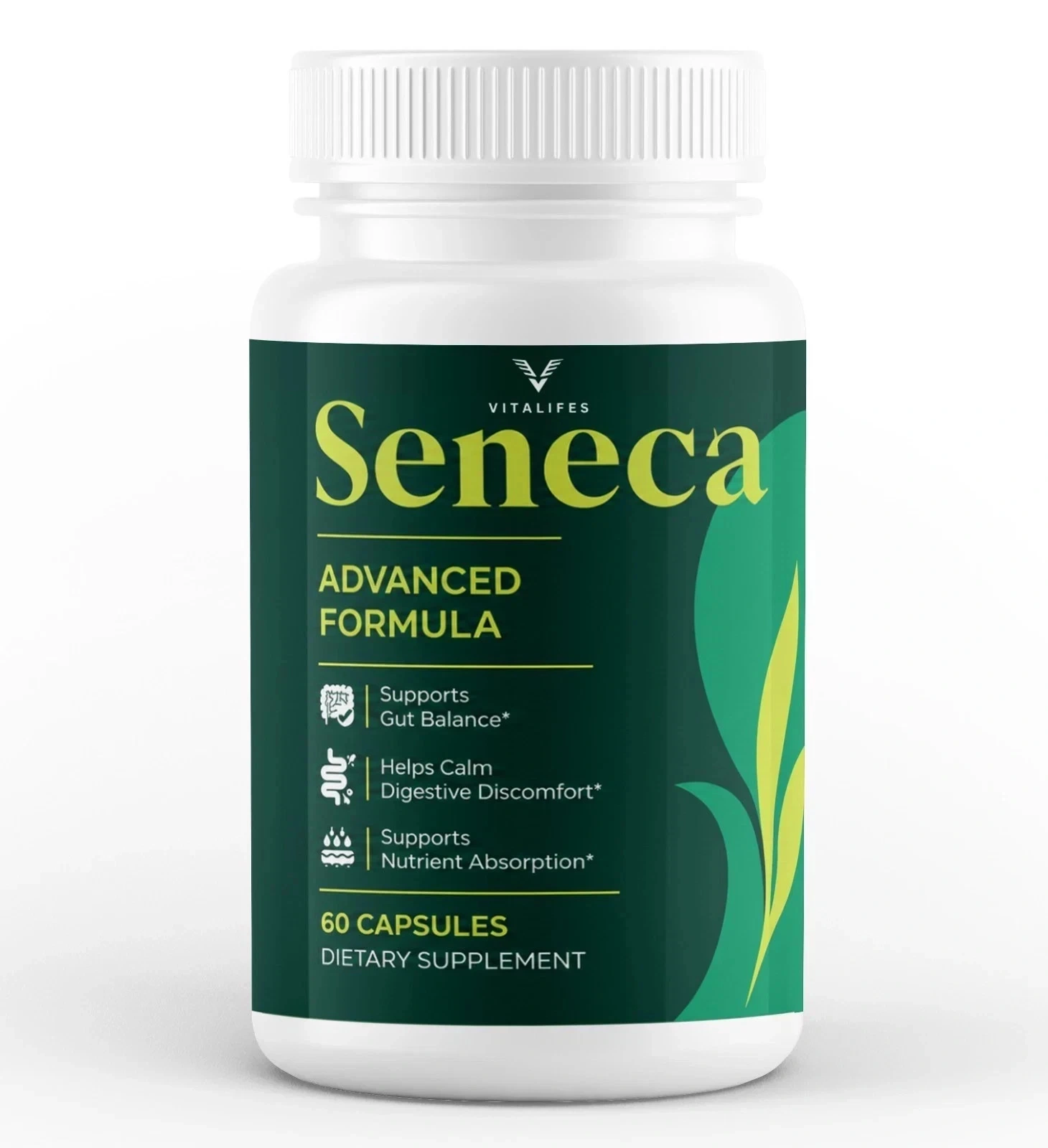
See what the Seneca label actually contains.
Check today’s price6. Digestive enzymes, for a known reason
Enzymes are the most specific product on this list and the easiest to judge. Lactase for lactose intolerance is a clear, mechanistic, well-established use. Pancreatic enzyme replacement for pancreatic insufficiency is a prescription matter and genuinely important.
Broad “digestive enzyme complexes” sold to people with no diagnosed deficiency are a much weaker proposition. If you know what you cannot break down, the matching enzyme is a sensible purchase. If you do not know, finding out comes first.
7. Herbal blends, honestly placed
Which brings us to the category this website is about. Herbal digestive products have a long traditional history: bitters before meals, peppermint for spasm, ginger for nausea, fennel for wind. Some of that has modern evidence behind it, particularly peppermint oil for IBS symptoms, and some of it is folklore with nothing underneath.
The problem with judging a blend is not that herbs are useless. It is that a blend with one total weight and nine names gives you nothing to judge. Apple cider vinegar, to take the most digestive-sounding ingredient on the Seneca panel, has little solid evidence behind the health claims made for it, and what research exists is mostly about blood sugar (National Center for Complementary and Integrative Health, “Apple Cider Vinegar”). Cinnamon is in the same position (National Center for Complementary and Integrative Health, “Cinnamon: Usefulness and Safety”).
So a herbal blend sits at the bottom of this list, not out of prejudice, but because it is the only entry where you cannot check what you are taking.
What to do this month
Pick one fibre change
Beans at two meals a week, or swapping one white carbohydrate for a wholegrain one. Just one.
Set a last-meal time
And keep it on five nights out of seven.
Add a ten-minute walk after your largest meal
This is the easiest win on the whole list.
Write three numbers a day
Comfort after meals, regularity, sleep hours. Ten seconds.
Change nothing else for four weeks
Then read your own notes and decide what earned its place.
When to stop experimenting and see a doctor
Some symptoms are not a lifestyle problem and should not be managed with a checklist. Blood in the stool, black stools, unexplained weight loss, difficulty swallowing, persistent vomiting, severe or night-waking pain, and a change in bowel habit lasting more than a few weeks all deserve a proper look.
So does a family history of bowel cancer, coeliac disease or inflammatory bowel disease. Coeliac disease in particular is commonly missed for years, and testing requires you to still be eating gluten, which is a good argument against cutting it on a hunch. Structure-function claims on supplement labels are not diagnoses, and the FDA is explicit that supplements are not intended to diagnose, treat, cure or prevent any disease (U.S. Food and Drug Administration, “Dietary Supplements: What You Need to Know”).
The bottom line
The things that help digestion most are free, slow and unmarketable: fibre from food, regular unhurried meals, water, movement, sleep and patience. The things that help some people for specific reasons are named strains and specific enzymes. The least certain option is a herbal blend whose amounts are not published.
If you buy Seneca or anything like it, buy it as the last item on that list rather than the first, and keep doing the boring things underneath it. That is not a sales pitch, and it is the honest version.
Sources
- National Center for Complementary and Integrative Health. Probiotics: What You Need To Know. NCCIH, current page. Checked September 24, 2026.
- National Center for Complementary and Integrative Health. Apple Cider Vinegar. NCCIH, current page. Checked September 24, 2026.
- National Center for Complementary and Integrative Health. Cinnamon: Usefulness and Safety. NCCIH, current page. Checked September 24, 2026.
- U.S. Food and Drug Administration. Dietary Supplements: What You Need to Know. FDA, current revision. Checked September 24, 2026.
Questions on this topic
More answers on the full FAQ page.
What helps digestion the most?
Eating more fibre from food, at regular unhurried meals, with enough water, movement and sleep.
Do I need a probiotic?
Most healthy people do not. They help some people for specific reasons, and the strain and CFU count are what make a product checkable.
How much fibre should I eat?
US guidance is roughly 25–38 grams a day depending on age and sex; most adults eat about half that.
When should I see a doctor?
Blood in the stool, unexplained weight loss, difficulty swallowing, persistent vomiting, severe pain, or a change in bowel habit lasting weeks.
Ready to try Seneca?
Pick a pack and see the price at checkout. The money-back guarantee is 60 days from purchase, unless the sales page prints a longer window. Questions first? Call the order desk at +1 (302) 200-3480.
Sold through a USA Authorized Seneca Retailer. This site is not the manufacturer and earns when you buy.Keep reading
What a 1,000 mg blend hides
What a proprietary blend means, what label order tells you, the arithmetic across nine ing…
Read more →What “probiotic formula” should mean
What a probiotic actually is, why the strain code and CFU count matter more than the word,…
Read more →Seneca ingredients
All nine parts of the 1000 mg blend.
Read more →