From the blog
Seneca Probiotic Check: Seneca® Probiotic: #1 Label Check of Strains and CFU Count [2026]
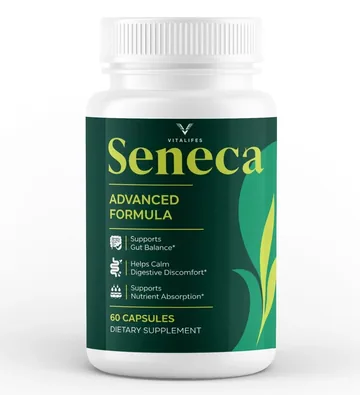
Seneca is not a probiotic by its own label. The Seneca probiotic wording comes from one seller image headed “Probiotic Formula”, but the Supplement Facts panel names no bacterial strain, no strain code and no CFU count. A useful probiotic label names the genus, species, strain and CFU count per serving, because effects are strain-specific. The nine Seneca ingredients are an amino acid, fruit, herbs and a flavour compound in one 1,000 mg blend.
What a probiotic actually is
The working definition, agreed between the WHO and the scientific societies that study this, is short: live micro-organisms which, when administered in adequate amounts, confer a health benefit on the host. Every part of that sentence is doing work.
Live means they have to survive manufacture, shelf life and your stomach acid. Adequate amounts means there is a number attached, usually in colony-forming units. Confer a health benefit means it has been shown to do something, for someone, for a particular reason.
What a probiotic is not is a category of vibe. NCCIH’s consumer page makes the point carefully: probiotics are not one thing, effects vary by strain and by condition, and evidence for one product does not transfer to another (National Center for Complementary and Integrative Health, “Probiotics: What You Need To Know”).
Why the strain matters more than the species
Bacteria are named in three parts. Genus (Lactobacillus), species (rhamnosus), strain (GG). Most people stop reading at the second one, and most marketing stops writing at the second one, and that is where the trouble starts.
Two strains of the same species can behave completely differently. They can produce different compounds, survive different conditions, stick to different parts of the gut and have entirely different research behind them. Saying a product contains Lactobacillus is roughly as informative as saying a vehicle contains an engine.
| Level | Example | How much it tells you |
|---|---|---|
| Genus | Lactobacillus | Almost nothing |
| Species | Lactobacillus rhamnosus | A little |
| Strain | Lactobacillus rhamnosus GG | Enough to look up the research |
| Strain plus dose | 10 billion CFU of L. rhamnosus GG | Enough to compare with a study |
What a good probiotic label prints
Here is the checklist. It takes about thirty seconds per product in a shop, and it eliminates most of the shelf.
Genus, species and strain code
All three, for every organism in the product.
CFU count per serving
And ideally “at end of shelf life” rather than “at time of manufacture,” which is a much weaker promise.
A best-before date
Live cultures decline over time; the date is part of the dose.
Storage instructions
Some strains need refrigeration. Shelf-stable ones should say so explicitly.
What it was studied for
Not a cure claim, but an honest pointer to why that strain is in there.
Notice what is not on that list: the words “advanced,” “complex,” “formula,” “gut health blend,” or a picture of a colon. None of those is information.
The Seneca case
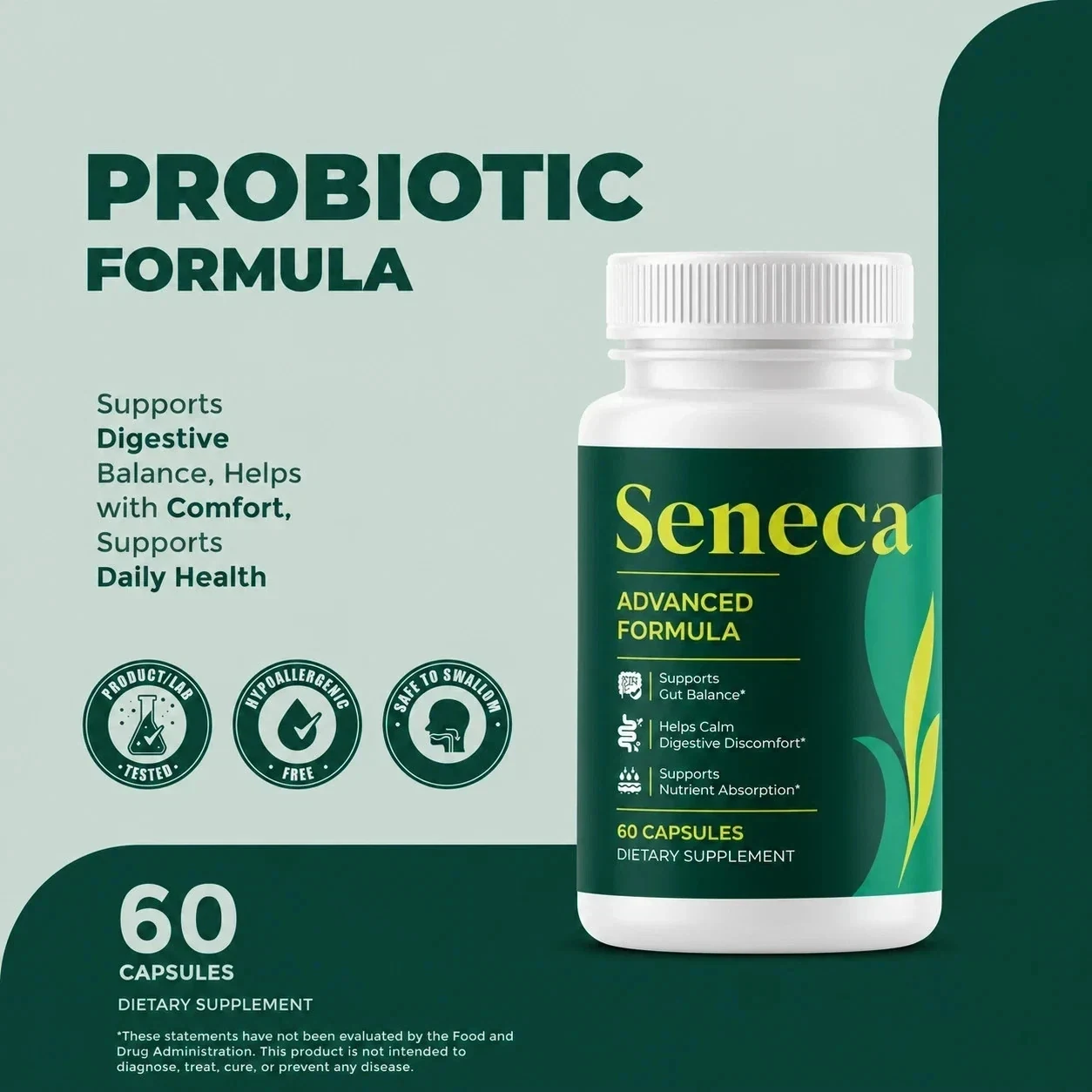
One of the seller’s images for Seneca is headed Probiotic Formula, in large type, above three roundels. Another image lists “carefully selected strains” as one of four features. A buyer scrolling a listing would reasonably conclude they were buying a probiotic.
The Supplement Facts panel tells a different story. It names nine ingredients: an amino acid, apple cider vinegar, garcinia cambogia, tongkat ali, horny goat weed, wild yam, cinnamon, bitter melon and raspberry ketones. There is no genus, no species, no strain code, no CFU count, and no storage instruction of the kind live cultures need.
| What a probiotic label shows | What the Seneca panel shows |
|---|---|
| Genus and species | None |
| Strain code | None |
| CFU count per serving | None |
| Storage advice for live cultures | None |
| Prebiotic fibre to feed them | None |
| Anything live at all | None |
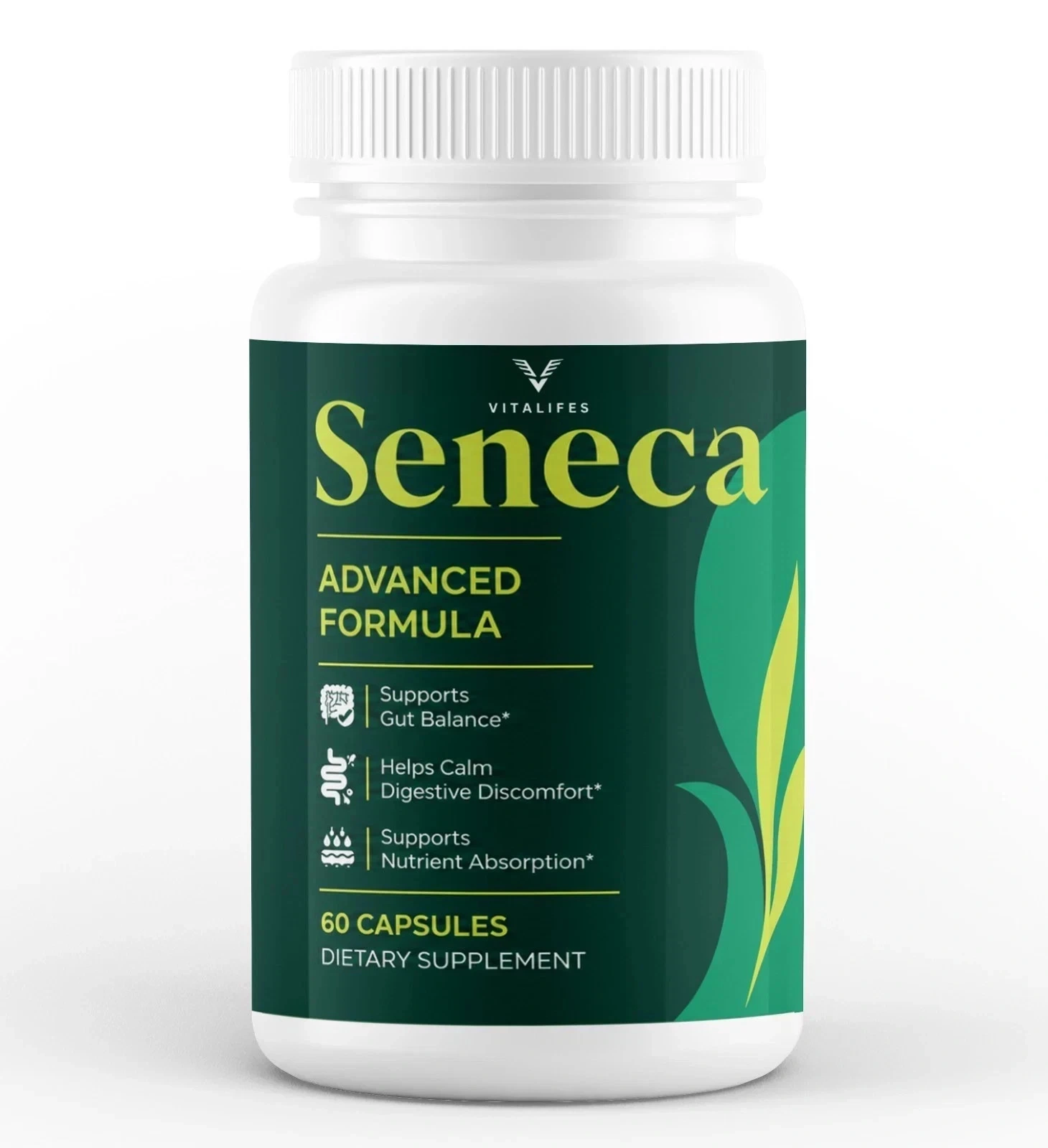
To be fair to the product: it never says “contains probiotics” on the bottle itself. The three front-of-bottle claims are about gut balance, digestive discomfort and nutrient absorption, all asterisked. The probiotic wording lives in the marketing images. That distinction matters legally and it matters to us, which is why this article separates the two.
It does not help the buyer much, though. Most people buy from the listing images, not from a photograph of the back label.
What else gets called “gut support”
Probiotics are only one of four things that legitimately sit under a digestive heading, and a useful label tells you which one you are holding.
| Category | What it is | What the label should print |
|---|---|---|
| Probiotic | Live organisms | Strain code and CFU |
| Prebiotic | Fibre that feeds your existing bacteria | Which fibre, and grams |
| Dietary fibre | Bulk and softening | Grams per serving |
| Digestive enzyme | Breaks down a specific nutrient | Activity units, not milligrams |
| Herbal bitter or carminative | Traditional use, thin modern evidence | Amount and standardisation, honestly labelled |
Seneca is closest to the last row, and even there the amounts are inside a blend. Apple cider vinegar is the ingredient with the most digestive folklore attached, and NCCIH’s summary is that there is little solid evidence for the health claims made about it (National Center for Complementary and Integrative Health, “Apple Cider Vinegar”).
See what the Seneca panel actually contains.
Check today’s priceHow to check any product in a shop
Turn it around
The front is advertising. The panel is regulated.
Look for three-part names
Genus, species, strain. If you only see two, put it down.
Find the CFU number
And check whether it is promised at manufacture or at expiry.
Check the storage line
A live product that says nothing about storage is worth a second look.
Match it to your reason
A strain studied for antibiotic-associated diarrhoea is not automatically the right one for bloating.
Ask the pharmacist
They do this every day and they are not selling you anything.
When a probiotic is worth buying
This article is not an argument against probiotics. It is an argument for reading the label. There are strains with genuinely useful evidence behind them for specific situations, and a pharmacist or dietitian can point you at the right one for your reason.
The general picture, as NCCIH puts it, is that some uses are better supported than others and that safety is good for healthy people but needs more care for people who are seriously ill or immunocompromised (National Center for Complementary and Integrative Health, “Probiotics: What You Need To Know”). That is a sensible, unexciting summary, and it is a long way from the word “probiotic” printed on a picture.
A note on fermented food
One thing worth saying, because it comes up every time this subject does: fermented foods and probiotic supplements are not the same category, and the difference is honest rather than snobbish.
Live yoghurt, kefir, sauerkraut, kimchi and miso carry live organisms, usually many of them, usually unnamed and uncounted. They are food, they are cheap, they carry other things your gut likes such as fibre, and the research on them is encouraging if less precise than strain-level trials. Nobody can tell you the CFU count of your sauerkraut, and for a food that is fine.
A supplement is a different proposition. You are paying for a specific claim, so the specifics are the thing you are buying, and a label that withholds them has sold you the packaging. If a product costs more than a tub of kefir and tells you less than the tub does, that is worth noticing.
The bottom line
A probiotic is a specific thing: a named strain, in a known amount, that has been shown to do something. The word on its own means nothing, and a product that uses it without printing a strain code and a CFU count has not given you anything to check.
For Seneca specifically: the panel contains no probiotic. If a probiotic is what you want, buy one that prints its strains, and let the label rather than the artwork decide.
Sources
- National Center for Complementary and Integrative Health. Probiotics: What You Need To Know. NCCIH, current page. Checked September 24, 2026.
- National Center for Complementary and Integrative Health. Apple Cider Vinegar. NCCIH, current page. Checked September 24, 2026.
- U.S. Food and Drug Administration. Dietary Supplements: What You Need to Know. FDA, current revision. Checked September 24, 2026.
- National Center for Complementary and Integrative Health. Garcinia Cambogia. NCCIH, current page. Checked September 24, 2026.
Questions on this topic
More answers on the full FAQ page.
Is Seneca a probiotic?
No. The Supplement Facts panel names no bacterial strain and gives no CFU count.
What is a CFU?
Colony-forming unit: a measure of how many live organisms are in a serving.
Why does the strain code matter?
Because effects are strain-specific. Research on one strain does not transfer to another of the same species.
Do probiotics need refrigeration?
Some strains do and some are shelf-stable. A good label says which.
Ready to try Seneca?
Pick a pack and see the price at checkout. The money-back guarantee is 60 days from purchase, unless the sales page prints a longer window. Questions first? Call the order desk at +1 (302) 200-3480.
Sold through a USA Authorized Seneca Retailer. This site is not the manufacturer and earns when you buy.Keep reading
What a 1,000 mg blend hides
What a proprietary blend means, what label order tells you, the arithmetic across nine ing…
Read more →What actually helps digestion
The things that genuinely settle everyday digestion, ranked: fibre, meal habits, water, sl…
Read more →Seneca ingredients
All nine parts of the 1000 mg blend.
Read more →